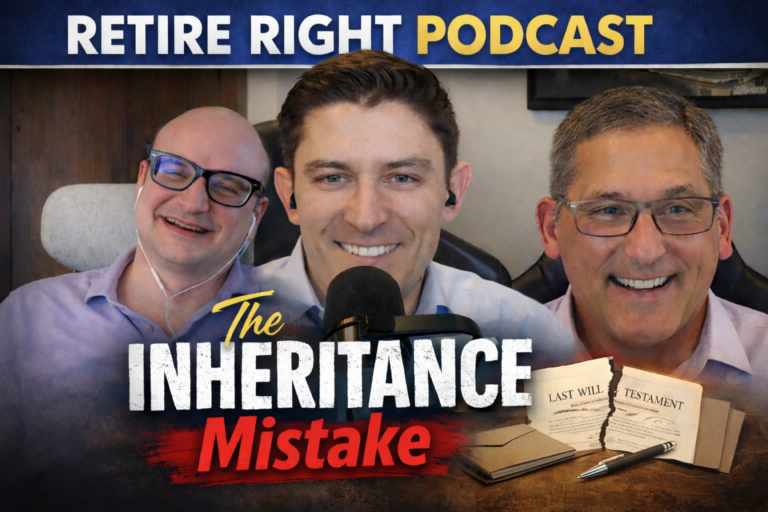
Here’s what we cover in this episode:
🧭 Are You Prepared?: key questions every family should address early
🛡️ Asset Protection Strategies: safeguarding what you’ve built for the future
🧓 Medicaid & Trusts: using the right tools to preserve assets and qualify for care
⚖️ Quality of Care: balancing asset protection with realistic long-term options
Executive Summary:
A basic estate plan generally involves a will, power of attorney and healthcare directives. However, more complex estates may require additional planning. For example, trusts can be established to protect assets and bypass the probate process. Advanced planning strategies involving trusts can also be used to minimize estate taxes.
Federal estate tax laws and exemptions change periodically. State estate and inheritance taxes vary by state and may apply separately.
A comprehensive financial plan should be coordinated with the estate plan. Beneficiary designations on investment accounts and life insurance policies should match the flow of the estate plan. Otherwise, assets may pass in unintended and suboptimal ways.
Asset Protection: Lifetime and Legacy
Asset protection can apply both during one’s lifetime and to one’s heirs upon death. At an advanced age, one may need to protect assets from the potentially ruinous cost of long-term nursing care. Monthly nursing home costs can run into the thousands—even tens of thousands. Proactive planning can involve using a trust to qualify for Medicaid benefits while preserving assets from spend-down rules.
Planning around long-term nursing care becomes increasingly relevant as individuals approach retirement. They must assess whether they can cover long-term care costs with their retirement income and assets. If long-term care costs are likely to exhaust their resources, they may need to pursue asset protection planning.
Long-Term Care Insurance and Medicaid Planning
A number of options are available to address long-term care costs. These include traditional long-term care insurance and hybrid life/long-term care insurance policies. Traditional long-term care insurance has become less common over time due to its high cost. Premiums have increased significantly as average life expectancies have extended. Hybrid policies are often more attractive. These combine a life insurance policy with a long-term care rider allowing access to the death benefit to cover long-term care expenses. For those who can neither self-insure, nor purchase an insurance solution, Medicaid planning may be required.
Medicaid Planning Overview
Medicaid is a joint federal-and-state health care program that provides medical coverage for low-income individuals. Crucially, unlike Medicare, Medicaid covers long-term nursing care. Medicaid eligibility is influenced by how assets are classified as countable or exempt, and the rules differ for single individuals and married couples. Medicaid eligibility rules vary from state to state.
Countable vs. Exempt Assets (Married Couples)
For a married couple, when one spouse needs nursing care:
- The spouse who remains at home is known as the community spouse.
- If the community spouse continues to live in the primary residence, the home is exempt.
- In Pennsylvania, the community spouse’s retirement accounts (such as IRAs and 401(k)s) are also exempt.
Countable assets, regardless of which spouse owns them, include:
- Checking and savings accounts
- Brokerage/investment accounts
- Other non-retirement financial assets
The community spouse is permitted to keep a portion of the couple’s countable assets, known as the Community Spouse Resource Allowance (CSRA). This amount is generally half of the total countable assets, with a maximum of approximately $160,000 adjusted annually and subject to state-specific rules.
If the couple’s assets exceed the allowed limit, spend-down strategies are used to reduce countable assets in a way that benefits the community spouse. One common approach is purchasing a Medicaid-qualified immediate annuity, which converts excess countable assets into an income stream payable to the community spouse. To meet Medicaid rules, such annuities must be irrevocable, non-assignable, actuarially sound, and name the state as the remainder beneficiary up to the amount paid by Medicaid.
Proactive Planning with Irrevocable Trusts
For long-term, proactive planning, an irrevocable asset protection trust may be used to protect the family home and certain financial assets. Ideally, this type of planning is done at least 5 years before long-term care is needed.
A common concern with irrevocable trusts is loss of control. However, these trusts can be designed so that:
- The settlors (creators) can sometimes retain investment-direction rights or even serve as trustees, depending on state law and attorney guidance, allowing them to maintain investment management control.
- The trust can be structured as a grantor trust, allowing the settlors to receive income from trust investments (interest, dividends, annuity payouts).
The settlors may choose how this income is handled:
- Withdraw all income,
- Withdraw only enough to cover taxes, or
- Leave the income in the trust (paying taxes from outside sources) to promote trust growth.
The Five-Year Look-Back Rule
Medicaid reviews any asset transfers or gifts made within the five years prior to the application. Transfers to an irrevocable trust made during this period may trigger penalties, creating a period of ineligibility for Medicaid. Therefore, to avoid penalty, trust planning should be completed more than five years before the need for care arises.
Crisis Planning (When Care Is Needed Now)
It is never too late to investigate asset protection strategies! Even in cases where no advanced planning was done, and an individual is already in a nursing home, there may be options for protecting at least a portion of the remaining assets.
For example, a single individual may do the following:
- Gift a portion of the assets (which triggers a period of Medicaid ineligibility), and
- Use the remaining assets to purchase a Medicaid-qualified immediate annuity that generates income to pay for care during the ineligibility period.
- This approach ensures the gifted assets are preserved, while the annuity covers care costs until Medicaid eligibility begins.
This type of strategy should be coordinated with an elder-law attorney.
Qualified Assets and Post-Mortem Protection
Qualified assets, such as traditional IRAs or 401(k)s, are generally protected from lawsuits. They are also exempt from Medicaid nursing home spend-down for a community spouse in Pennsylvania. Protection levels vary and should be verified based on state law. It’s important to know that to move qualified assets into an irrevocable trust for asset protection, the assets must first be withdrawn from the qualified account. This withdrawal is a taxable event and may result in a significant tax bill.
Inherited qualified accounts are subject to certain distribution rules (in most cases the accounts must be depleted within 10 years). A “see-through trust” may be used to provide these assets with additional protection, while preserving tax deferral benefits over the distribution period. Such trusts allow beneficiaries to access the money, while protecting any funds remaining in the trust. This is particularly effective in protecting inherited qualified assets from divorce, as the trust assets are not considered marital assets.
Authors:
Ryan Wyatt, CFP®, CIMA®
Nick Lewandowski, CFA®, CFP®
Resources:
Get your personalized Retire WYZE Assessment: A simple 3-step process where you can evaluate our services and expertise to make an informed decision about hiring a wealth advisor.
Click here for other ways to contact the team.
Explore case studies to see how we’ve helped clients.
This communication is provided by Wyze Wealth Advisors LLC, a registered investment adviser. All material is for informational and educational purposes only and should not be considered personalized investment advice or a recommendation regarding any specific security, strategy, or product.
The assumptions and scenarios presented are illustrative and do not reflect actual investment results. Projections are based on current market conditions, which may change. Past performance is not indicative of, and does not guarantee, future results. All investments involve risk, including the potential loss of principal.
Investment decisions should be made based on an individual’s objectives, risk tolerance, time horizon, and financial circumstances. Additional information about our services, fees, and Form ADV Part 2A is available upon request.
This material is for informational purposes only and does not constitute legal or tax advice. Medicaid eligibility, estate planning, and trust strategies are complex legal matters that vary by state and individual circumstances. Before implementing any legal or asset protection strategy, consult a qualified elder-law attorney and tax professional.